Chemical reaction engineering is a fundamental part of chemical engineering education, but many important concepts can be difficult to appreciate through equations and theoretical models alone. Practical laboratory experiments give students the opportunity to observe how changing operating conditions affects reactor performance and to compare theoretical predictions with measurable results.
At Armfield, we design educational equipment that helps bridge this gap between classroom theory and practical engineering. Armfield’s continuous stirred tank reactor (CSTR), the CEM-MKII, provides a flexible small-scale teaching solution that enables students to investigate important principles including reaction kinetics, conversion, residence time, mixing, temperature effects and feed conditions.
When used alongside Armfield’s CEXC teaching system, the CEM-MKII provides an accessible way to demonstrate how a continuous stirred tank reactor behaves under different operating conditions.
What Is a Continuous Stirred Tank Reactor?
A continuous stirred tank reactor, commonly abbreviated to CSTR, is a type of reactor in which reactants are continuously introduced while products are continuously removed. Agitation is used to promote mixing within the vessel, helping to produce relatively uniform conditions throughout the reactor.
CSTRs are important in chemical engineering because their principles can be applied to many industrial reaction processes. Understanding their behaviour requires students to consider several interacting variables, including:
- reaction rate;
- reactor volume;
- residence time;
- mixing intensity;
- feed rate;
- flow rate;
- temperature;
- reactant concentration; and
- conversion.
Working with Armfield’s continuous stirred tank reactor (CSTR) allows students to investigate these variables experimentally rather than considering them only through mathematical models.
This practical approach can make concepts such as mass balances, reaction kinetics and residence time considerably easier to understand.
Introducing the Armfield CEM-MKII
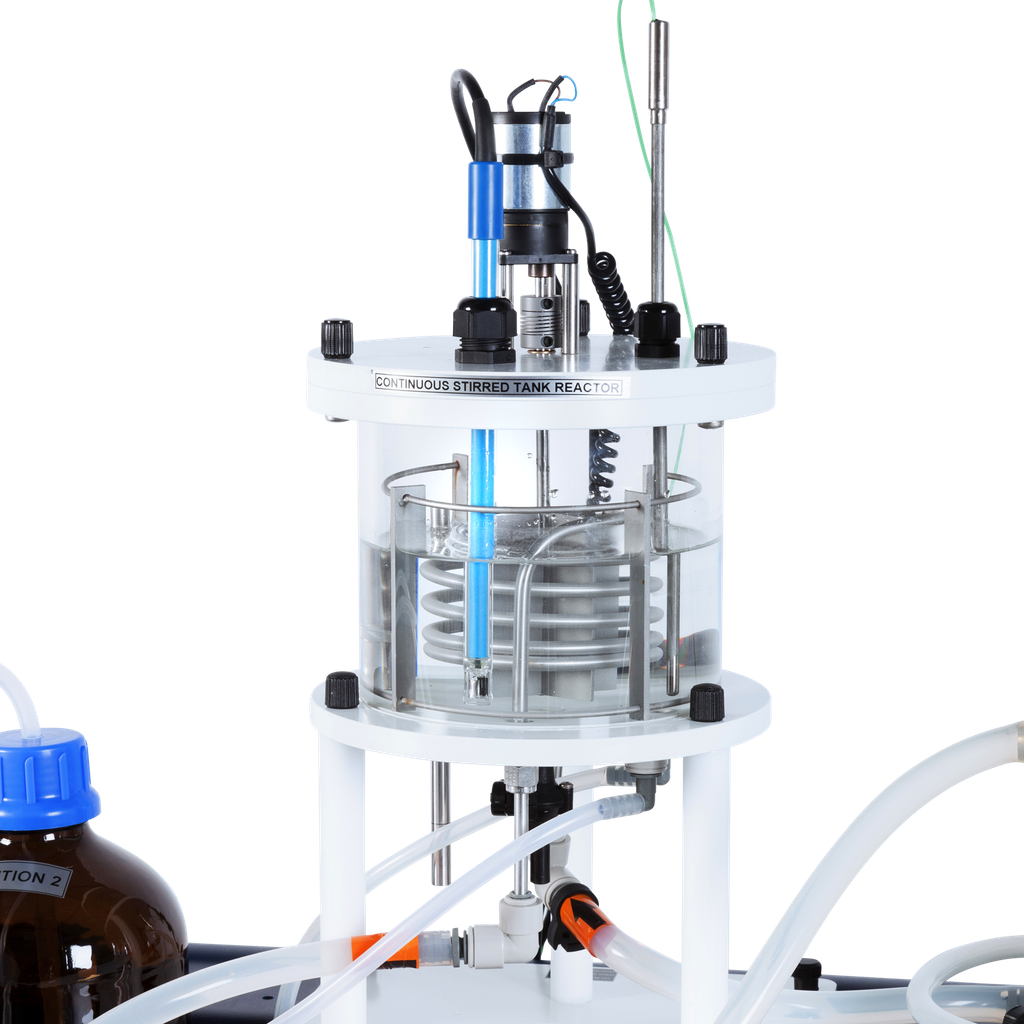
The CEM-MKII continuous stirred tank reactor (CSTR) is designed specifically for chemical engineering education and laboratory demonstration.
It is a small-scale reactor that supports both continuous and batch reactions, giving lecturers considerable flexibility when developing practical teaching sessions.
One particularly useful feature of Armfield’s continuous stirred tank reactor (CSTR) is its adjustable working volume. By changing the reactor volume, students can explore how hold-up and residence time influence reaction behaviour.
The unit also incorporates variable-speed agitation. This enables experiments examining an important practical issue in reaction engineering: the extent to which mixing affects reactor performance.
Instead of assuming that a vessel is perfectly mixed, students can observe the consequences of changing agitation and compare experimental behaviour with theoretical assumptions.
Exploring Residence Time
Residence time is one of the most important concepts associated with continuous reactors.
In simple terms, residence time describes how long material remains within the reactor before leaving it. The relationship between reactor volume and feed flow therefore plays an important role in determining how much opportunity a reaction has to proceed.
With the CEM-MKII, students can adjust operating conditions and examine how changes influence residence time and conversion.
Residence time distribution experiments provide an additional level of understanding. Real reactors do not always behave exactly like ideal mathematical models, and residence time distribution can help students investigate how material actually moves through a reactor.
Using tracer techniques and step changes enables students to relate experimental measurements to the theoretical concepts introduced during reaction engineering lectures.
Understanding the Importance of Mixing
Mixing is another fundamental aspect of CSTR operation.
The ideal CSTR model assumes that material inside the vessel is perfectly mixed. Under ideal conditions, the concentration and temperature at the reactor outlet should therefore correspond to conditions within the reactor.
In real systems, however, mixing effectiveness depends on equipment design and operating conditions.
The variable-speed agitator used with Armfield’s continuous stirred tank reactor (CSTR) enables students to investigate this relationship directly.
Students can compare reaction behaviour at different mixing speeds and examine what happens when agitation becomes insufficient. Such experiments help demonstrate why assumptions made in theoretical reactor models need to be considered carefully when applying those models to practical engineering systems.
This is an important learning outcome because industrial reactor design rarely involves considering a single variable in isolation.
Investigating the Effect of Temperature
Temperature can have a major influence on chemical reaction rates.
Reaction engineering courses commonly introduce relationships between temperature and reaction rate through kinetic theory and equations. Practical experimentation gives students the opportunity to see those relationships reflected in real measurements.
When the CEM-MKII is used with Armfield’s CEXC teaching system, temperature conditions can be investigated as part of structured reactor experiments.
Students can compare results obtained at different temperatures and evaluate how reaction rate changes.
This helps connect theoretical discussions of reaction kinetics with physical reactor operation and experimental data.
It can also encourage students to consider wider engineering questions such as temperature control, heat transfer and the importance of maintaining appropriate process conditions.
Exploring Feed Rate, Flow Rate and Conversion
Changing the rate at which reactants enter a continuous reactor can significantly influence its behaviour.
Increasing flow rate generally reduces the time material spends inside a reactor of a given volume. This relationship means that feed conditions can influence both residence time and overall conversion.
With Armfield’s continuous stirred tank reactor (CSTR), students can investigate the effects of changing feed and flow conditions.
Rather than simply being told that flow rate affects conversion, students can collect measurements, analyse their results and determine whether experimental observations agree with theoretical predictions.
This process develops several important engineering skills, including:
- experimental planning;
- data collection;
- interpretation of results;
- comparison of theory and practice;
- identification of experimental uncertainty; and
- technical analysis.
These skills are valuable well beyond a single reaction engineering module.
Connecting Reaction Kinetics with Experimental Data
Reaction kinetics can become mathematically demanding, particularly when students begin working with rate expressions, rate constants and reactor design equations.
Practical laboratory work provides context for these calculations.
Using the CEM-MKII, students can perform experiments designed to investigate reaction rate and determine kinetic information from measured results.
For example, conductivity can be used during suitable reactions to monitor changes as the reaction progresses. Measurements can then be analysed to explore reaction behaviour and evaluate empirical rate expressions.
This creates a useful connection between three stages of engineering learning:
theory → experiment → analysis
Students first learn the relevant reaction engineering principles, then operate the equipment and collect data, before finally using that data to evaluate theoretical relationships.
Continuous and Batch Reaction Teaching
An additional advantage of the CEM-MKII continuous stirred tank reactor (CSTR) is the ability to support both continuous and batch reactions.
These operating modes provide educators with opportunities to demonstrate differences between reactor configurations and operating strategies.
Batch experiments can help students understand reaction progression with time, while continuous experiments introduce steady-state operation, continuous feed, outlet flow and residence-time concepts.
Providing both approaches through a flexible teaching system can help laboratories make more effective use of their available equipment.
Using the CEM-MKII with Armfield’s CEXC Teaching System
The CEM-MKII is designed for operation with Armfield’s CEXC teaching system.
Together, these systems provide a practical platform for chemical reaction engineering education. Relevant measurements and operating variables can be incorporated into structured laboratory exercises, enabling students to move beyond observation and perform quantitative analysis.
Typical areas of investigation can include:
- determining reaction rate constants;
- examining the effect of temperature on reaction rate;
- investigating different reactor volumes;
- changing mixing speed;
- studying variations in feed rate;
- examining flow rate and conversion;
- determining residence time using tracer techniques;
- investigating inadequate mixing; and
- evaluating reaction-rate expressions using experimental data.
The result is a teaching environment in which several fundamental concepts of reactor engineering can be examined using one integrated experimental approach.
Helping Students Think Like Engineers
The objective of laboratory education should not simply be to reproduce a predetermined result.
Students benefit most when experiments encourage them to ask why a system behaves in a particular way.
What happens to conversion when flow rate increases?
How does changing reactor volume affect residence time?
Does increasing agitation always improve reactor performance?
How closely does experimental residence time distribution match the ideal CSTR model?
What happens to reaction rate when temperature changes?
Questions such as these encourage students to interpret data rather than merely record it.
Armfield’s continuous stirred tank reactor (CSTR) provides educators with a practical way to build these questions into reaction engineering laboratory sessions.
A Practical Solution for CSTR Teaching
At Armfield, our focus is on creating teaching equipment that makes engineering principles observable, measurable and easier to understand.
For institutions looking for a practical solution for teaching continuous stirred tank reactor (CSTR) principles, reaction kinetics, residence time, mixing, conversion and the influence of operating conditions, the CEM-MKII provides a highly flexible platform.
Its ability to support continuous and batch experiments, combined with adjustable working conditions and integration with Armfield’s CEXC teaching system, allows educators to demonstrate multiple aspects of reaction engineering within a structured laboratory environment.
Whether the teaching objective is to introduce students to basic CSTR behaviour or investigate more detailed relationships between temperature, flow, mixing, kinetics and conversion, Armfield’s continuous stirred tank reactor (CSTR) provides a strong practical foundation.
Bring Reaction Engineering Theory into the Laboratory
If you are developing or upgrading a chemical engineering teaching laboratory and would like to explore how the Armfield CEM-MKII continuous stirred tank reactor (CSTR) and CEXC teaching system could support your courses, our team can help you identify the most appropriate experimental configuration for your teaching requirements.
Contact Armfield to discuss your laboratory requirements and discover how our chemical reaction engineering teaching solutions can help students turn theoretical reactor concepts into practical, measurable experience.